Professor Earle Abrahamson, University of Hertfordshire, UK, EuroSoTL Board Member
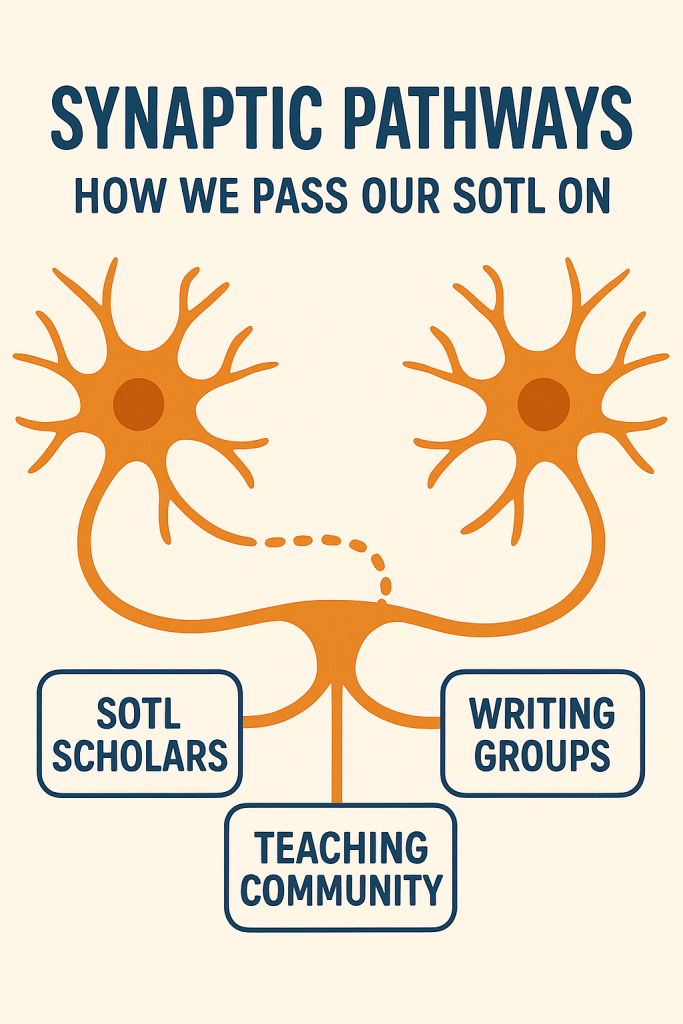
When I think about how we share the Scholarship of Teaching and Learning I return again to the idea of the synapse. In the body a synapse is the place where one cell passes its signal to another. Nothing moves unless the synapse is active. Nothing grows unless the signal is received. The idea of transmission sits at the heart of SoTL too. We may carry rich insights about learning but unless we pass them on with care intention and clarity they fail to shape wider practice.
The central question for me is simple. How do we make our SoTL discoverable and alive to others. Academic life is full of valuable inquiry that remains hidden in folders and conversations that never reach new listeners. To strengthen our SoTL culture we need to design strong synaptic pathways that carry our work beyond our immediate circles.
One crucial synapse is the connection between SoTL scholars and the wider teaching community. Many colleagues engage in thoughtful exploration of their practice but do not label it as SoTL. To reach them we need steady and open channels of communication. This can be as simple as presenting at local teaching events sharing short reflective pieces or inviting colleagues into small inquiry groups. These acts work like neurotransmitters. They bridge the space between interest and understanding. They help others recognise their own activity as inquiry and in turn they begin to pass their knowledge forward.
Students also play an important role in the transmission of SoTL. When we involve them in inquiry they carry the story of our work into classrooms study groups societies and sometimes even beyond the institution. Their voices travel fast and with great authenticity very much like messages in a well myelinated neural pathway. If we want our SoTL to spread students are not only partners in research but partners in dissemination. They help ideas move at speed and with meaning.
Writing groups and communities of practice form another key synapse. These spaces allow SoTL scholars to exchange work in progress to test claims and to refine messages before sharing them more widely. They also create supportive conditions to sustain regular output. Without these groups many SoTL projects slow down or fade. With them the transmission of ideas remains steady and strong. The act of writing together deepens our confidence and increases the likelihood that our work reaches conferences journals and networks where others can learn from it.
To promote SoTL more effectively we also need to attend to the distractors that interrupt transmission. Heavy workloads limited recognition and unclear routes for dissemination often weaken our signals. These pressures act like damage to the myelin sheath. They slow the movement of ideas until they lose strength. If we want our SoTL to travel we must protect the time and space required to write present and talk about our work. We must also advocate for structures that value SoTL as core academic activity rather than an optional addition.
When synapses fail in the human body the whole system is affected. The same is true in our SoTL networks. If we do not make our work visible if we do not pass it on with intention our insights stay local and our influence remains limited. But when we cultivate active synapses the effect is transformative. Ideas spark across classrooms faculties and institutions. Our community grows more confident more connected and more capable of shaping meaningful change.
The task before us is not only to create SoTL but to transmit it. To send it with clarity. To ensure it reaches someone who can pass it on again. When we strengthen these synaptic pathways we turn individual inquiry into collective understanding. We keep SoTL alive as a shared endeavour and we create a culture where every insight no matter how small has a chance to travel and make a difference.